
Step-by-Step Core Guidelines for Body Temperature Assessment and Management: A NANDA-I Framework for Clinical Nursing
In clinical nursing practice, accurately monitoring and managing body temperature is a cornerstone of vital signs assessment. While pyrexia (fever) serves as an adaptive physiological response to pathogens, unmanaged hyperthermia can trigger severe metabolic distress, cellular damage, and neurological complications.
This professional clinical guide outlines the systematic approach to thermoregulation assessment and nursing interventions, structured sequentially according to the NANDA International (NANDA-I) nursing process.
1. Assessment (Data Collection)
The clinical precision of the entire nursing care plan depends on the accuracy of initial objective and subjective data collection.
Technical Modality Selection & Site Optimization
- Axillary (Axilla): Preferred for non-invasive, routine screening, though it reflects peripheral temperature rather than core temperature (Normal range: 35.5°C – 37.0°C).
- Oral (Sublingual): Highly accessible for cooperative adult patients. Ensure the probe is placed deep in the posterior sublingual pocket (Normal range: 36.5°C – 37.5°C).
- Tympanic Membrane (Otoscopic): Reflects core body temperature rapidly via the carotid artery supply. Ensure proper ear canal alignment (pull pinna up and back for adults, down and back for infants) (Normal range: 35.8°C – 38.0°C).
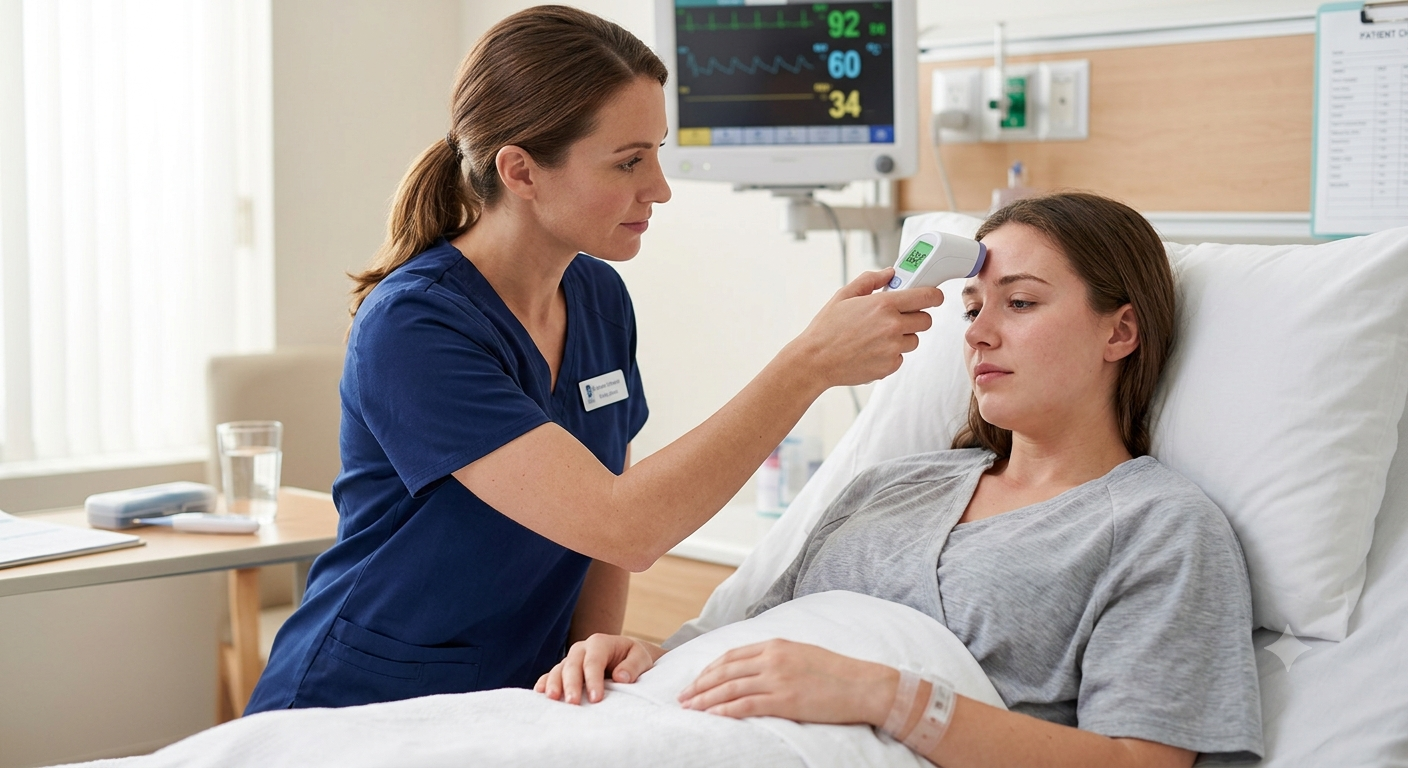
- Temporal Artery (Forehead): Utilizes infrared scanners across the temporal artery. Ideal for rapid screening across diverse age demographics (Normal range: 35.8°C – 38.0°C).
- Rectal: The gold standard for absolute core temperature measurement, indicated in critical care or neonatal settings (Normal range: 36.6°C – 38.0°C).
Confounding Factors & Pre-measurement Protocol
- Delay Parameters: Postpone oral or tympanic measurement for 20–30 minutes if the patient has recently consumed hot or cold fluids, smoked, masticated gum, or engaged in strenuous physical exertion.
- Environmental Baseline: Evaluate ambient room temperature, humidity, and the insulation level of the patient’s bedding/clothing.
Clinical Classification Baseline
- Hypothermia: < 35.0°C
- Normothermia: 36.5°C – 37.5°C
- Subfebrile (Low-grade fever): 37.6°C – 38.2°C
- Hyperpyrexia / Severe Hyperthermia: ≥ 38.3°C
2. Nursing Diagnosis (NANDA-I Taxonomy)
Upon evaluating the objective physiological indicators, clinical diagnostic labels are assigned based on NANDA-I Domain 11 (Safety/Protection – Class 6: Thermoregulation):
- Hyperthermia (00007): Body temperature elevated above normal diurnal range due to failure of thermoregulation (e.g., related to dehydration, increased metabolic rate, or an infectious process).
- Risk for Deficient Fluid Volume (00028): Vulnerable to a decrease in intravascular, interstitial, and/or intracellular fluid, related to hypermetabolic states, insensible fluid loss via diaphoresis (sweating), and Comic-strip tachypnea.
- Ineffective Thermoregulation (00008): Temperature fluctuations between hypothermia and hyperthermia.
3. Planning & Expected Outcomes (NOC – Nursing Outcomes Classification)
Establish measurable, time-restricted clinical goals tailored to the specific NANDA diagnosis.
- Short-Term Outcome: The patient’s core body temperature will decrease by 0.5°C – 1.0°C within 60 to 90 minutes following the implementation of non-pharmacological and/or pharmacological interventions.
- Long-Term Outcome: The patient will maintain normothermia (36.5°C – 37.5°C) over a 24-hour period, demonstrating balanced fluid intake and output (I/O) without secondary neurological or metabolic decompensation.
4. Implementation (Nursing Interventions – NIC)
Nursing actions are executed systematically, prioritizing non-invasive cooling mechanisms followed by collaborative medical treatments.
A. Non-Pharmacological Cooling Interventions
- Evaporative and Convective Cooling: De-clothe the patient down to a single layer of loose, breathable cotton garments. Remove heavy linens, quilts, or blankets.
- Tepid Sponge Bathing (Warm Compress Application): For temperatures exceeding 38.5°C, apply clean washcloths moistened with tepid water (32°C – 35°C) to high-vascularity zones: axillary regions, inguinal creases, and the anterior neck.
Critical Contraindication: Never use cold water, ice packs, or isopropyl alcohol. These induce intense vasoconstriction and shivering, which paradoxically raises core body temperature via shivering thermogenesis.
- Aggressive Fluid Resuscitation: Compensate for elevated insensible fluid losses. Encourage oral hydration with water or electrolyte solutions if the patient is conscious and has an intact swallow reflex. Monitor intravenous (IV) fluid infusion lines as prescribed.
- Microclimate Adjustment: Utilize fans or air conditioning to optimize ambient room temperature to a range of 21°C – 23°C, ensuring no direct cold drafts hit the patient.
B. Pharmacological Interventions (Collaborative Care)
- Antipyretic Administration: Administer prescribed antipyretic agents (e.g., Acetaminophen/Paracetamol, Ibuprofen) in strict accordance with the physician’s order, verifying dosage, timing, and route to avoid hepatic or renal toxicity.
5. Evaluation
The final stage closes the loop of the nursing process, measuring the exact efficacy of the clinical interventions.
- Re-assessment Timeline: Re-evaluate and document body temperature exactly 30 to 45 minutes post-intervention utilizing the identical measurement site and device to ensure clinical consistency.
- Symptomatic Assessment: Continuously assess for the resolution of associated symptoms: reduction in tachycardia/tachypnea, termination of diaphoresis, return of normal skin turgor, and improved cognitive neurological status.
- Clinical Re-routing: If hyperthermia persists or escalates despite interventions, notify the attending physician immediately, initiate blood/urine culture protocols if ordered, and pivot back to Step 1 (Assessment) for a comprehensive diagnostic review.
⚠️ MEDICAL DISCLAIMER & LIMITATION OF LIABILITY
Educational and Informational Purposes Only: The content provided on this website, including but not limited to text, graphics, images, nursing care plans, NANDA diagnoses, and other material, is for academic, educational, and informational purposes only. It is designed to support nursing students and healthcare professionals in their theoretical studies and should not be used as a substitute for professional medical judgment, diagnosis, or clinical treatment.
No Clinician-Patient Relationship: Accessing, reading, or interacting with this content does not establish a nurse-patient, clinician-patient, or professional advisory relationship between you and this website or its authors.
Limitation of Liability: While we strive to present accurate, up-to-date, and evidence-based clinical protocols, medical guidelines change rapidly. The owners, authors, and affiliates of this blog make no representations or warranties of any kind, express or implied, regarding the completeness, accuracy, reliability, or suitability of the information contained herein. Any reliance you place on such information is strictly at your own risk. Under no circumstances shall this blog, its creators, or administrators be held liable for any direct, indirect, incidental, consequential, or punitive damages, injuries, or adverse clinical outcomes resulting from the use or misuse of the information provided on this website. Always consult with a qualified physician or healthcare provider regarding specific medical conditions or treatment plans.